Vietnamese cats (mèo ta): calico, tabby, black and other familiar house cats
Mèo ta is what Vietnamese people call their familiar short-haired house cats. Meet calico, tabby, black, ginger and tuxedo cats and see why they are loved.
When Vietnamese people say mèo ta, literally "our cats", they mean the familiar short-haired house cats found in city townhouses and village homes across the country. Mèo ta is not an officially recognized breed. It is an affectionate name for local cats, which people usually tell apart by coat color and pattern.
What "mèo ta" actually means
Mèo ta is the everyday Vietnamese term for local domestic cats, as opposed to pedigree breeds with written standards such as the British Shorthair or the Persian. The closest English equivalent is "domestic shorthair". These cats have lived alongside Vietnamese families for generations, catching mice in the kitchen, napping on motorbike seats and sunning themselves on balconies.
Because there is no pedigree to name them by, people describe them by their coats:
- Tam thể: calico, with three colors.
- Mướp: tabby, with stripes.
- Mun: solid black.
- Vàng: ginger or orange.
- Bò sữa: black and white, like a dairy cow.
- Xám tro: ash grey.
One thing worth remembering: a coat tells you very little about personality. Two tabbies from the same street can be completely different characters.
Calico cats (mèo tam thể)
A calico cat has a coat in three colors, white, orange and black, arranged in patches. In Vietnam, the calico is probably the cat that appears most often in folk sayings and family stories.
Here is a surprising fact: almost all calico cats are female. The reason is genetic. The gene that produces orange or black fur sits on the X chromosome. A female cat has two X chromosomes, so she can carry orange and black at the same time. A male usually has only one X chromosome, so he normally shows just one of the two colors. Male calicos do exist, but they are very rare, usually because they carry an extra X chromosome.
Tabby cats (mèo mướp)
A tabby has a striped coat, usually grey or brown with darker bands, and often a clear "M" shape on the forehead. Tabby is a pattern, not a breed, so tabbies turn up in pedigree cats and street cats alike. The stripes can be narrow and even, broad and swirled, or broken into spots.
Mèo mướp are very common in Vietnam, and people often praise them as quick, clever and good at catching mice. A much-loved variation is the bobtail tabby (mướp đuôi cộc), with a short or kinked tail.
Black cats (mèo mun)
A mèo mun has a solid black coat, usually with striking yellow or green eyes. Folk beliefs about black cats vary a great deal from culture to culture: some see them as unlucky, others as a sign of good fortune. For the people who live with them, a black cat is simply a companion, often a very affectionate one, and a glossy black coat in the sunlight is hard to beat.
Ginger, black and white, and grey cats
- Mèo vàng (ginger cats): orange or pale yellow fur, often with faint stripes. Most ginger cats are male, for the same X chromosome reason that makes calicos mostly female.
- Mèo bò sữa (black and white cats): large patches of black and white, like the markings on a dairy cow. English speakers often call them tuxedo or bicolor cats.
- Mèo xám tro (grey cats): an even, ash grey coat that looks calm and soft. Cat breeders usually call this color "blue".
Why Vietnamese people love mèo ta
Mèo ta are part of everyday Vietnamese life. They are used to the hot, humid climate, adapt well to small homes and busy streets, and are generally not fussy eaters. Many people grew up with a mèo ta at their grandparents' house, so seeing a tabby or a calico on a doorstep brings back childhood memories.
Cats even have a place in the calendar. In the Vietnamese zodiac, the Year of the Cat takes the spot that the Rabbit holds in the Chinese zodiac; the most recent one was 2023.
If you are thinking of getting a cat, adopting a mèo ta from a local rescue group is well worth considering. Many cats are waiting for a home. Before your new companion arrives, read our checklist for bringing a new kitten home.
Raise a mèo ta in a game
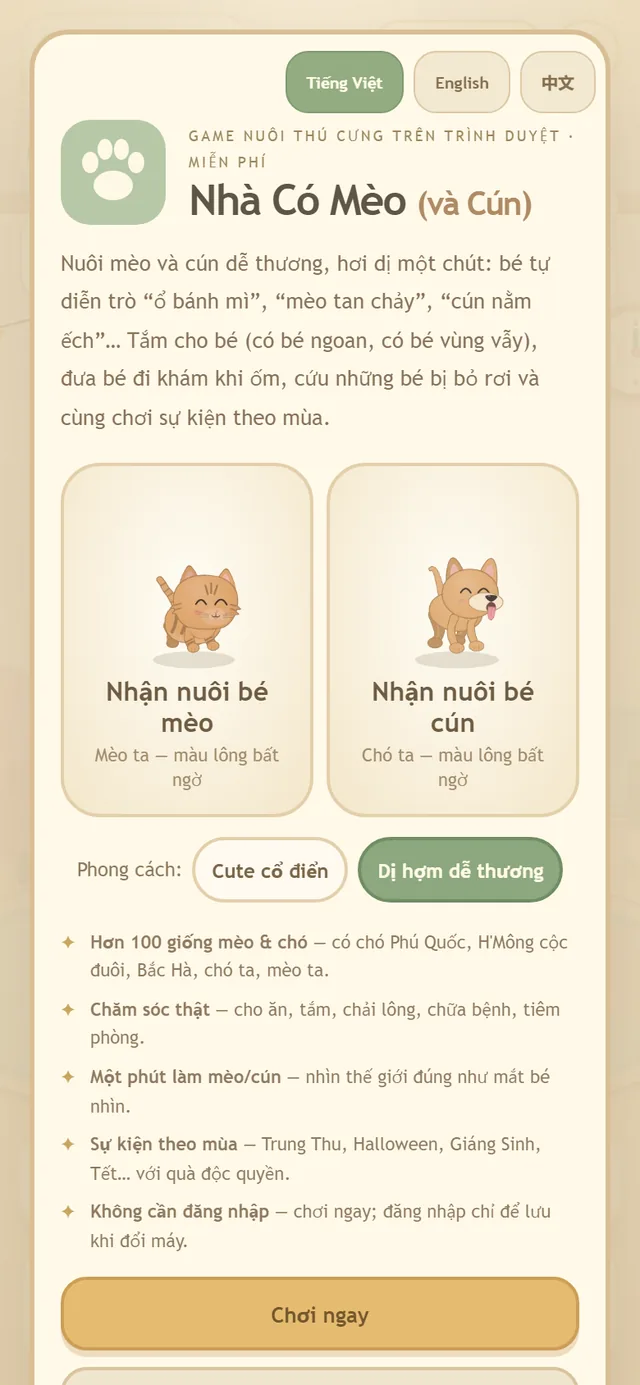
Not ready for a real cat yet? You can start with a virtual one. In Nhà Có Mèo, a browser game by TrioX Studios, you can adopt calico, tabby, black, ginger, black and white, grey and bobtail tabby cats, alongside more than 100 cat and dog breeds. Each pet has its own personality: they ask for food, demand baths, steal each other's toys and sometimes fall ill and need a trip to the clinic. They never die.
The game is free, has no real-money top-ups, and its rewarded ads for gifts are entirely optional: they only appear when you choose to watch one. It runs in English, Vietnamese and Chinese at nhacomeo.io.vn. Read our introduction to Nhà Có Mèo, the Nhà Có Mèo beginner's guide, or our tips on choosing a cat game.
Frequently asked questions
Is mèo ta a cat breed?
No. Mèo ta is a Vietnamese nickname for local short-haired house cats, similar to "domestic shorthair" in English. There is no official breed standard behind it.
Are all calico cats female?
Almost all of them. The orange and black coat colors are carried on the X chromosome, so a cat usually needs two X chromosomes to show both. Male calicos are rare.
Why are most ginger cats male?
A male cat needs only one copy of the orange gene on his single X chromosome to be ginger, while a female needs it on both of her X chromosomes.
Can I adopt Vietnamese cats in Nhà Có Mèo?
Yes. The game includes familiar Vietnamese cats such as calico, tabby and black cats, plus Vietnamese dog breeds, and you can play straight away in your browser without signing in.