Physics and gravity puzzle games: how they work, why they hook you and tips
What is a physics puzzle game? How gravity, momentum and collisions drive these games, why they are so addictive, tips for hard levels and classic examples.
Physics puzzle games are games where the solution lies in how things fall, roll, bounce and collide. You do not just think of an answer; you set things up and let gravity do the rest. Here is how the genre works, why it is so hard to put down, some tips for tough levels and the classics that shaped it.
What is a physics puzzle game?
A physics puzzle game is a puzzle game that uses a physics engine to decide what happens after you act. You cut a rope, launch an object, draw a line or place a plank, and then gravity and collisions determine the outcome.
Unlike pure logic puzzles, where each move has one fixed result, physics puzzles are continuous: angle, force and timing all matter. That is why a level often has several solutions, and sometimes the "weird" one works best. It is one branch of the puzzle family; you can explore the others in our guide to video game genres.
Common mechanics
Most physics puzzle games revolve around a few rules we already know from real life:
- Gravity: everything falls. Many games let you flip it, like VVVVVV, where the hero reverses gravity to walk on the ceiling.
- Inertia and momentum: moving things keep moving. Portal is famous for keeping your momentum as you pass through a portal.
- Collisions and bounce: objects bounce, topple and roll when they touch. Angry Birds is built almost entirely around smashing structures.
- Ropes and pendulums: Cut the Rope uses hanging ropes and swinging motion.
- Liquids: Where's My Water? has you dig through dirt to guide water to the right place.
- Building structures: World of Goo lets you build towers and bridges from blobs of goo that stick together.
Classic physics puzzle games
A few games helped define the genre:
- Cut the Rope: cut the ropes at the right moment so the candy swings and drops into the mouth of the little monster Om Nom.
- Angry Birds: slingshot birds into the green pigs' structures. Angle and point of impact decide everything.
- World of Goo: build structures from goo balls that are just stable enough not to collapse.
- Where's My Water?: dig a path for water to reach Swampy the alligator's bathtub.
- Crayon Physics Deluxe: shapes you draw in crayon become real, weighted objects you use to push a ball to a star.
- Portal: use a portal gun and falling momentum to get through test chambers.
Why are physics puzzles so addictive?
Physics puzzles hook you because they rely on rules everyone has known since childhood, so you understand them almost instantly while there is still room for surprise.
- Easy to grasp, hard to master: everyone knows things fall, but predicting exactly where takes a sharp eye.
- Fast trial and error: an attempt takes seconds, so failing never feels heavy.
- Visual feedback: you see immediately why you failed, no explanation needed.
- Chain reaction moments: watching a sequence of collisions play out exactly as planned is deeply satisfying.
- Many solutions: it feels creative, not like hunting for a single right answer.
Tips for hard levels
The most important tip is to observe before you act: where is the goal, where is the thing you need to move, and what stands in the way?
- Work backwards from the goal: from which direction, and with how much momentum, does the object need to arrive?
- Break the level into small steps: clear the first obstacle before planning the rest.
- Watch your timing: often you have the right direction at the wrong moment.
- Use momentum instead of fighting it: one good swing can solve a whole tricky section.
- Change one small thing at a time: nudge your line or tweak the angle, then see what changes.
- Step away and come back: a rested mind often spots a new route.
- Use step-by-step hints: revealing part of a hint keeps the joy of solving it yourself.
- Leave side goals for later: clear the level first, then return for all the stars or items.
CUTVERSE: a gravity puzzle game from TrioX
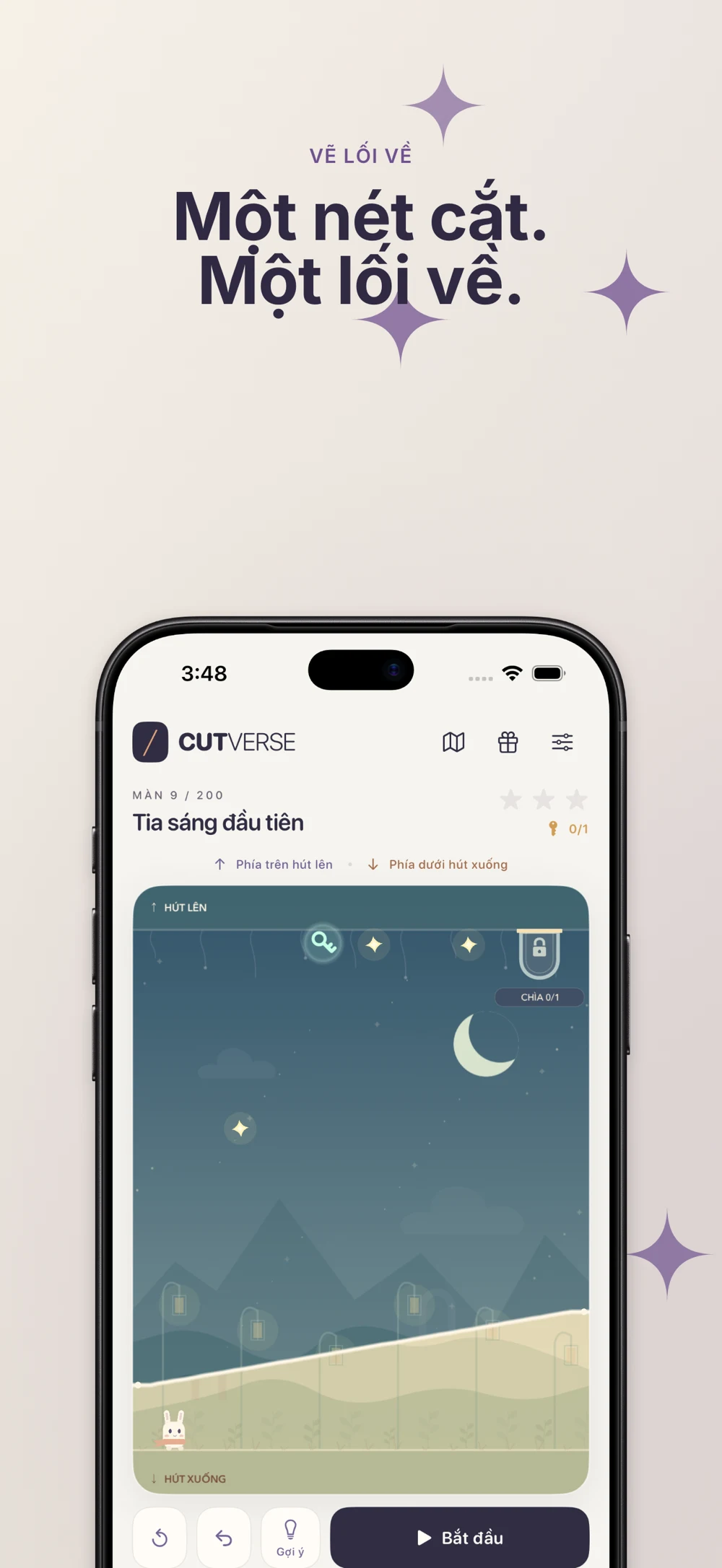
CUTVERSE is a gravity puzzle game for iPhone that TrioX Studios is preparing for release. The core idea fits in one sentence: you draw a cut, everything above it pulls up and everything below it pulls down.
Your goal is to guide Mimo to a glowing door. Mimo keeps momentum, so the challenge is not only where to draw but when to change gravity. Later levels add keys, bounce pads, portals, wind, switches and shields.
CUTVERSE includes tools that fit the approach above: step-by-step hints, undo, redraw and the option to leave a hard level for later. There are 200 levels across 12 chapters, with 600 optional stars for completionists. Everything runs on your device without internet, and it is free with no ads or in-app purchases.
To learn more about the game's world and characters, read CUTVERSE, a gravity puzzle game.
Frequently asked questions
Are physics puzzle games good for kids?
Many are, because the rules are visual and need little reading. Still, check for ads and in-app purchases before handing one to a child. Our guide to choosing safe games for kids lists what to look for.
Is Angry Birds a puzzle game?
Yes. Angry Birds is usually classed as a physics puzzle game, since each level is a problem about angle, force and how a structure collapses.
How is a gravity puzzle game different from a physics puzzle game?
A gravity puzzle game is a branch of physics puzzles where controlling or flipping gravity is the main mechanic, as in VVVVVV or CUTVERSE.