Detective games on your phone: solving cases, cracking ciphers and Pocket Evidence
What makes a good mobile detective game, how to solve Caesar, Polybius and Vigenère ciphers, and an introduction to Pocket Evidence by TrioX Studios.
A detective game puts you in the role of the investigator: you read clues, compare statements, decode messages and reach your own conclusion. If you are looking for a mystery or cipher game to play on your phone, this guide explains what makes a good case, how to solve a few common ciphers, and introduces Pocket Evidence, the detective game TrioX is finishing.
What is a detective game?
A detective game is one where the main reward is the moment you work out the truth yourself. It is not about fast reflexes. It is about reading closely and connecting two details that seemed unrelated.
On phones, detective games usually come in three flavors:
- Scene exploration: tap around a scene to find objects, often close to hidden-object games.
- Case files: clues live in letters, reports, messages and schedules. You read, compare and reason.
- Cipher puzzles: clues are encrypted, and you need to find the right method to read them.
Many games mix all three. For a wider view, see our overview of game genres.
What makes a good mystery game?
A good mystery game is fair: everything you need to reach the answer is already in the game. Other signs to look for:
- It asks you to prove, not just guess. Picking the culprit by luck is not satisfying. A good game also asks "which evidence shows that?".
- Hints come in layers. The first hint points you where to look, later ones say more. That way you keep the satisfaction of solving it.
- No rush. Timers suit action games, but mysteries need time to reread.
- Room for notes. A place to jot down names, times and suspicions saves you from holding everything in your head.
- No interruptions. An ad in the middle of a deduction is the fastest way to lose your train of thought.
What is a cipher? 6 types you will meet
A cipher is a message transformed by a rule, so only someone who knows the rule can read it. These are classic ciphers that often appear in detective games and outdoor puzzle hunts.
- Caesar cipher: shift every letter a fixed number of places in the alphabet. With a shift of 3, TRIOX becomes WULRA.
- Atbash: reverse the alphabet, so A becomes Z, B becomes Y and M becomes N. CAT becomes XZG.
- Polybius square: place letters in a 5 x 5 grid and replace each with its row and column numbers. With the letters in order from A to Z (I and J sharing a cell), HELLO becomes 23 15 31 31 34. In a keyed square, the letter order is shuffled by a keyword.
- Vigenère cipher: like Caesar, but each letter shifts by a different amount, set by the matching letter of a keyword. Without the key it is hard to guess.
- Book cipher: numbers point to a page, line and word in a book that both sender and receiver own.
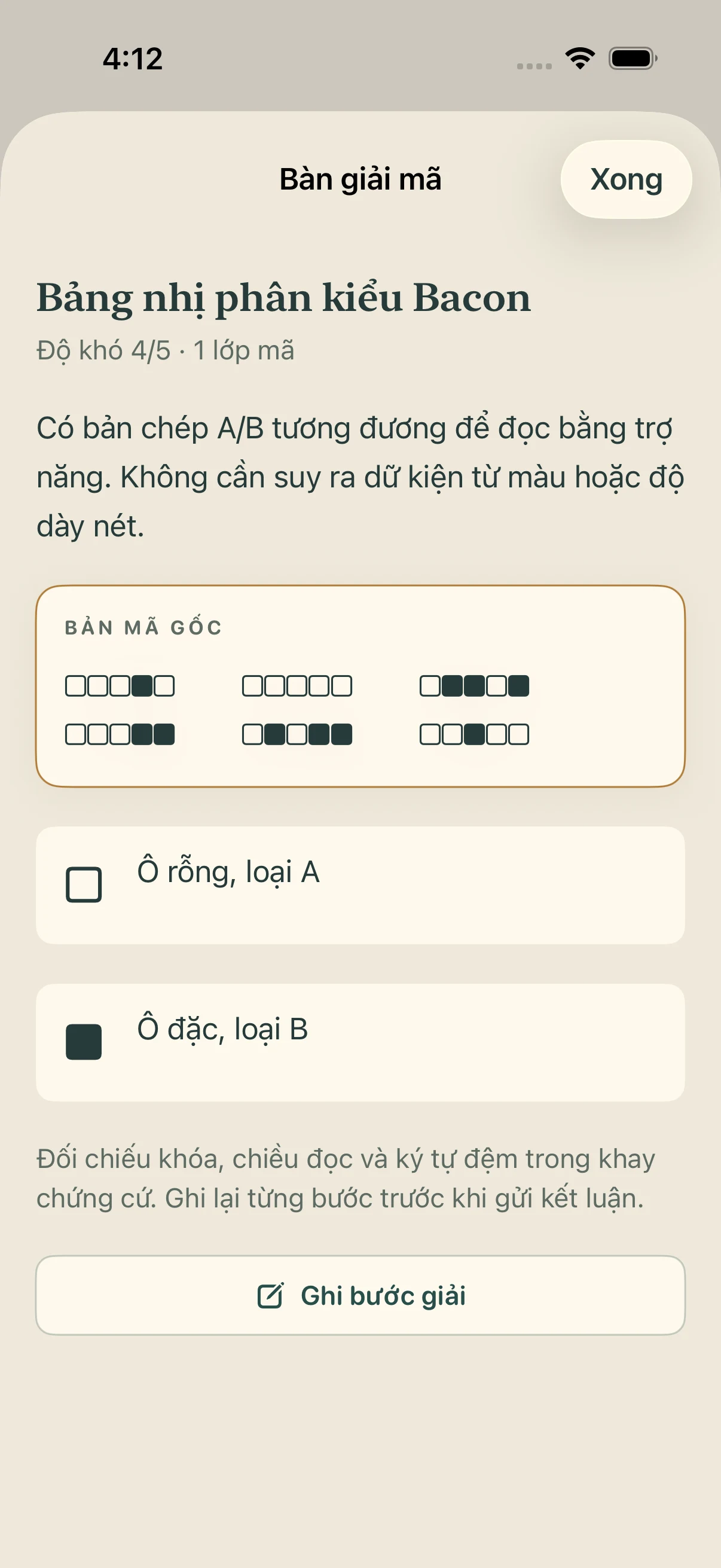
- Bacon's cipher: each letter becomes a group of five symbols of two kinds, usually written A and B. The two kinds can be hidden as empty and filled squares or two typefaces.
Tips for solving cases and ciphers
The most important tip is to write down every step, including the wrong ones. Then:
- Put two records side by side. Contradictions hide in small details: a meeting time, a signature date, a name spelled differently.
- Build a timeline. Putting events in order often shows who could not have been where.
- Find the key before decoding. For ciphers, look for the key, reading direction and padding characters. The key is often hidden in the file itself.
- Try simple ciphers first. If the ciphertext is all letters, try Caesar and Atbash. If it is pairs of numbers from 1 to 5, think Polybius.
- Use hints one layer at a time. Open the lowest hint first, think a little longer, then open the next.
Pocket Evidence: the detective game TrioX is finishing
Pocket Evidence, called Hồ Sơ Bỏ Túi in Vietnamese, is an iPhone detective game by TrioX Studios. Version 1.1.0 is being prepared for release on iOS 16 or later. Its tagline is "Read clues. Prove your case."
On your first day at Windharbor, a character named Mira hands you a parcel with an uncertain recipient. From there you work through 24 case files: three introductory assignments, a nine-part artifact-swap mystery and twelve original Silver Bird cipher files. All characters, places and events are fictional.
When we built Pocket Evidence, we followed the same checklist:
- Prove it with evidence. You choose an answer and the records that prove it. You can pin two records side by side and reorder the timeline.
- Three hint levels that open only when you ask, never for money.
- A decoding workbench for each cipher, showing difficulty out of 5, the number of layers, its own rules and reference table, plus a button to record each step. Ciphers include Caesar, Atbash, Polybius, Vigenère, book ciphers, a Bacon-style binary table and three-layer chains.
- Accessible decoding. Ciphers made of empty and filled squares include an A/B transcript for screen readers, so color is never required.
- Offline and uninterrupted. No account, no ads and no in-app purchases. Progress and notes stay on your device. The game is in English and Vietnamese, and you can switch language mid-story without starting over.
If you prefer games that work without a connection, our guide to offline games has more ideas.
Frequently asked questions
Are detective games suitable for children?
It depends on each game's content. Check the store age rating and look through the story first. Our guide to choosing safe games for kids lists what to check.
Can I play a cipher game with no cryptography knowledge?
Yes, if the game explains the rules as you play. In Pocket Evidence, each cipher file has its own rules and reference table, plus three hint levels.
Is Pocket Evidence on the App Store yet?
Not yet. The game is being finished and prepared for release on iPhone. The product page will be updated once a download link is available.
Do I need the internet to play Pocket Evidence?
No. All 24 case files and resources are bundled in the app. Progress is stored only on your device, with no sync between devices, so deleting the app can remove your progress.