Localizing games and apps for Vietnamese and English: get it right from day one
Localizing games and apps between Vietnamese and English: string files, text length, Vietnamese diacritics, fonts, store screenshots per language and culture.
Localization means making a game or app feel natural to people in another language and culture, not just translating the words. A good English version should not feel like it was written in Vietnamese first, and the other way around. This guide covers what to get right from the start, with examples from the bilingual products at TrioX.
How is localization different from translation?
Translation moves meaning from one language to another; localization moves the whole experience. It covers wording, interface, date and currency formats, images, character names and even jokes.
Product names are the clearest example. The photo sharing app from TrioX Studios is called Tụi Mình in Vietnamese and Little Us in English. The names are not word-for-word translations, but both suggest a small, close-knit group. The taglines work the same way: "Những khoảnh khắc nhỏ, gần hơn với người thương" in Vietnamese, "Your little moments. Your favorite people." in English. You can read more about the app in our article on private photo sharing apps.
Keep strings out of your code
Strings are every piece of text users see: buttons, notifications, titles, dialogue. The first step of localization is never hard-coding text. Give each string a key and store it in a separate file for each language.
A few rules:
- Use meaningful keys, like "settings.backup.title", instead of numbers.
- Do not build sentences from fragments. "You have " + n + " messages" breaks in languages with a different word order. Use a single string with a placeholder.
- Handle plurals: Vietnamese words do not change with quantity, but English has "1 level" and "2 levels". Use your platform's plural support, such as String Catalogs on iOS.
- Add context notes for translators: is "Save" a button that stores data or an invitation to save money?
Doing this from day one is far cheaper than digging through the whole project to remove hard-coded text later.
Text length and layout
Text length changes between languages, so your interface must flex. Vietnamese and English sentences with the same meaning can differ a lot in length, especially in short buttons and headings.
- Design buttons and cards that grow with their content, and avoid fixed widths.
- Allow headings to wrap, and test with text about one and a half times longer than usual.
- Test with large text sizes from the phone's accessibility settings.
- In games, watch for text baked into images: if words are painted into artwork, you need a new image for every language.
Vietnamese diacritics and fonts
Diacritics are where things break most easily when a product is built in English first and Vietnamese is added later. Stacked marks such as "ể", "ặ" and "ỗ" need a font that fully supports the Vietnamese alphabet and leaves enough room above and below the line.
Check your font:
- Type a sentence full of diacritics, such as "Người Việt ưa ổn định, thích nghỉ ngơi ở quê nhà."
- See whether marks are clipped at the top of a line or collide with the line above.
- Test uppercase with diacritics, such as "ĐIỀU KHOẢN", since marks on capitals get clipped most often.
- If a display font lacks Vietnamese glyphs, choose a different font for Vietnamese instead of letting the system mix fallback fonts.
Beyond display, normalize Unicode for search and sorting: the same "ế" can be stored in two different encodings, which makes searches fail to match.
Store screenshots and product pages per language
Screenshots on the App Store or Google Play are what people see before they read anything, so give each language its own set. Both stores let you set a different name, description and screenshots per language; see the official pages from Apple and Google Play for details, since requirements can change. Our article what is ASO explains why your store page affects discovery.
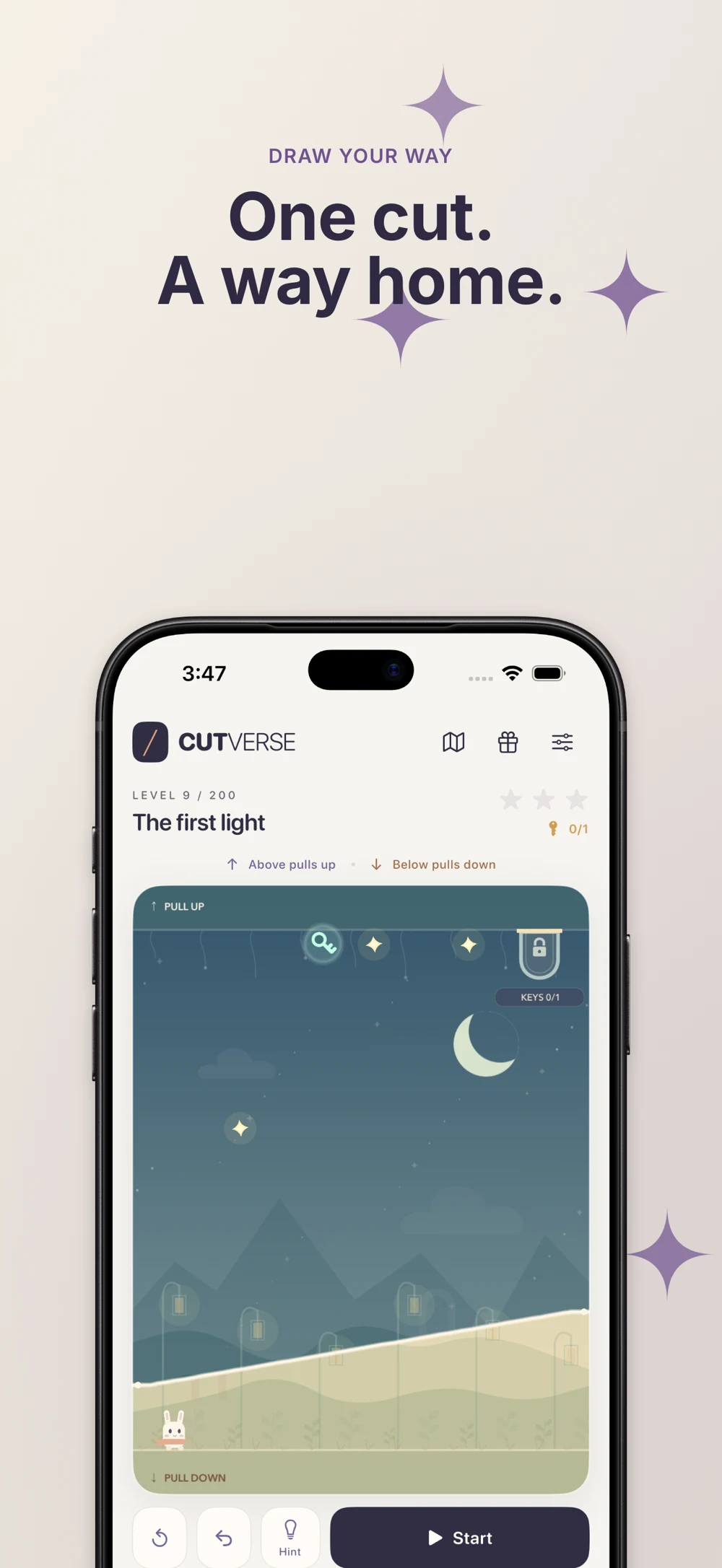
At TrioX, CUTVERSE has a separate cover image and screenshot set for Vietnamese and English, and so does Little Us for its today, private group, journal and widget screens. Lịch Nhà is different: its app interface is currently in Vietnamese, so the artwork on its English page is clearly labeled as showing the Vietnamese interface. Being honest about interface language keeps people from being disappointed after they download.
Culture: what machine translation cannot do
Cultural differences decide whether a "correct" translation actually fits.
- Names and places: in Hồ Sơ Bỏ Túi, the English title is Pocket Evidence, the town of Bến Gió becomes Windharbor and the Chim Bạc ciphers become the Silver Bird files. The names are rewritten to carry a similar mood in each language.
- Letter-based puzzles: ciphers, crosswords and wordplay need content redesigned per language, not just translated. Our article on the Hồ Sơ Bỏ Túi mystery game talks more about this kind of puzzle.
- Concepts unique to one place: death anniversaries, the lunar calendar and Vietnamese forms of address need explaining or an equivalent phrasing.
- Colors, symbols and gestures can mean different things elsewhere.
A lean localization workflow for small teams
For a small team, a simple process is good enough:
- Extract strings and pick a language file format from the start.
- Write a clear, concise source text; a messy original produces a messy translation.
- Translate by rewriting naturally, with context notes.
- Have a native reader play through the whole thing, not just read the string file.
- Capture store screenshots for each language.
- Every time you add a feature, update both languages at once.
Frequently asked questions
Should I use machine translation or AI for localization?
It is fine for a first draft, but someone who knows both languages should review it and play it in context, because machines easily miss tone and wordplay.
When should I localize?
Prepare the technical side from the start, even if your first release has one language. Adding languages later will be much easier.
Does a bilingual app need two store pages?
You do not need two apps. One app can declare several languages, each with its own name, description and screenshots on the same store page.
TrioX builds apps, games and AI solutions on request. Get in touch via our home page.