Hiring a team for an app, game, website or AI: what to prepare, what drives cost
Before you hire someone to build an app, game, website or AI solution: what to prepare, what drives the cost, a sample workflow and the questions to ask.
Before you hire a team to build an app, game, website or AI solution, get clear on your goal, your users, the core features and a rough budget range. There is no fixed price: cost depends on scope, platforms, design, servers, AI and maintenance after launch. This guide helps you prepare, understand where costs come from and know what to ask when choosing a team.
What should you prepare before reaching out?
You do not need a thick technical spec, but you should be able to answer these questions:
- The problem: who the product helps, what it does and why they need it.
- Users: customers, internal staff, students or children? Each group brings different design and privacy requirements.
- Core features: the three to five things the first version must do. Put everything else on a "later" list.
- References: apps, games or websites you like or dislike, and why.
- Existing assets: logo, brand identity, content, data and any systems that need to connect.
- Timeline and budget range: a rough range helps the team propose something realistic instead of quoting for things you do not need.
- Decision makers: who approves designs, signs off on deliverables and answers questions along the way.
What drives the cost?
Cost is mostly the time of the people doing the work, so anything that adds work adds cost.
Feature scope
The number of screens, user roles (guest, admin, staff), sign-in, payments, notifications, chat and reporting. A feature that sounds simple, like "messaging", brings storage, notifications, moderation and abuse reports with it.
Platforms
Web only, iPhone only, both iOS and Android, or iPad, Apple Watch and widgets as well. Each platform adds building, testing and release work. A web app that opens on any device is often an economical first step to validate an idea.
Design
A standard system interface or a custom design, with or without illustration, animation and sound. Games usually need more effort on art, audio and balancing than a utility app.
Servers and infrastructure
Does the app keep data on the device, or does it need servers, a database, photo storage and backups? Beyond building it, there are ongoing running costs such as hosting, domains and email delivery.
AI
Calling a model through an API means paying per use; running a model on the device avoids per-call fees but is limited by the hardware; a question answering system over your own documents needs extra work preparing data. Also budget for testing answer quality and filtering personal information. Building an AI product from an idea and AI chatbots for business go deeper.
Release and maintenance
Developer accounts, privacy policy, store screenshots and review; then bug fixes and updates for new OS versions and new store requirements. This is recurring work, not a one-time job. See publishing on the App Store and privacy policies for apps.
A sample workflow
Every team works a little differently, but a clear process usually includes:
- Discovery: listen to the goals, ask follow-up questions, propose a direction and first-version scope.
- Quote and plan: feature list, milestones, deliverables at each milestone and payment terms.
- Design: screen flows and an interactive prototype you can tap through before coding starts.
- Development in short cycles: a working build after each cycle for you to review.
- Testing: on real devices, multiple screen sizes and realistic data.
- Release: store pages, policies, review submission and server deployment.
- Handover and maintenance: source code, accounts, operating docs and a post-launch support agreement.
Questions to ask a development team
- Have you built something similar? Is there a live product I can try?
- Who will actually work on the project and be my contact?
- What does the quote include and exclude: servers, store accounts, content, image licenses?
- Will I own the source code, store accounts, domain and data?
- How are changes handled mid-project?
- How long is bug support after launch, and how are store requirement updates handled?
- Where is user data stored, and who can access it?
One important note: your Apple Developer and Google Play accounts should be in your name or your company's, so the app always belongs to you. Be careful, too, if a team quotes very quickly without asking about users or features, promises everything in a very short time, or will not say who keeps the source code.
TrioX Studios builds on request
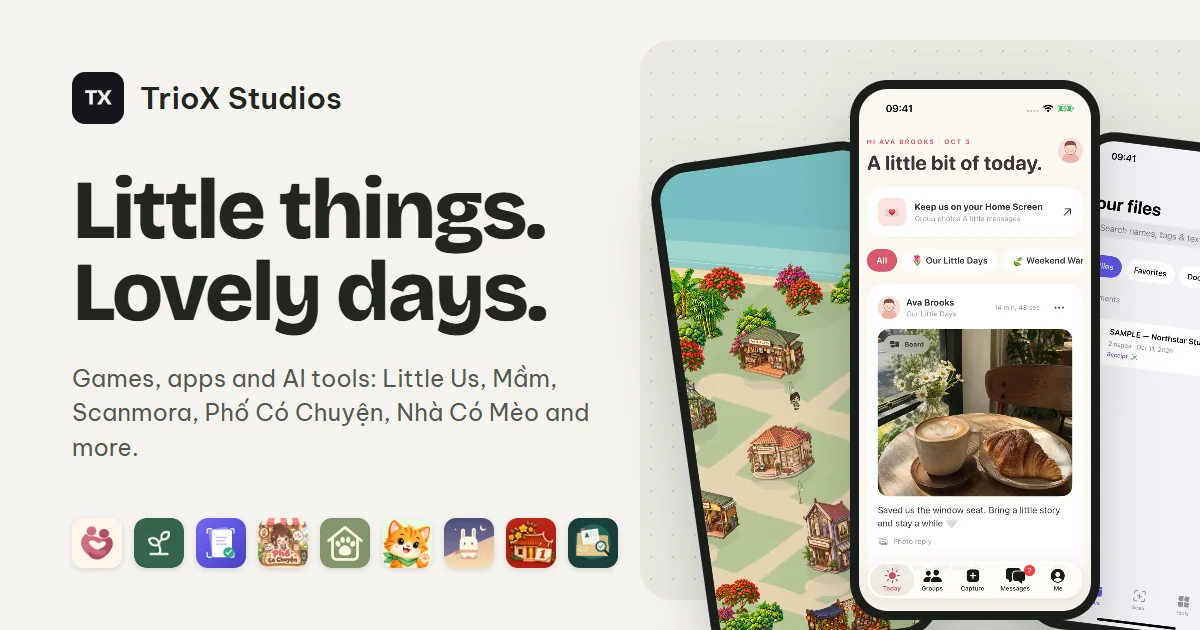
TrioX is an independent studio making games, iOS apps, web apps and AI solutions. You can try our real products before we talk: Little Us is an iPhone app live on the App Store, Phố Có Chuyện is a web game with more than 20 jobs and AI-powered character chat that players can turn off, and Mầm is a classroom learning platform with quizzes and team games. Scanmora, a document scanning app with an AI assistant that runs on the device, is being finished.
TrioX builds apps, games, websites and AI solutions on request, with pricing quoted per project. Send a short description of your idea through our services section or email trachanhtv.works@gmail.com, and we will work with you to pin down the scope.
Frequently asked questions
How long does it take to build an app?
It depends on scope. A first version with few features can be done much faster than a full product. Ask for a plan broken into milestones rather than a single number.
Should I build an app or a website first?
If you need to validate an idea quickly and reach every device, the web is often a sensible first step. If you need widgets, offline use or deeper access to device hardware, an installed app fits better.
Do I need to know how to code to hire a developer?
No. You need a clear understanding of your users and goals; the team should explain the technical side and make recommendations.