Remembering death anniversaries and lunar dates in Vietnamese families
How Vietnamese families keep track of death anniversaries, rằm, mùng một and lunar birthdays: lunar calendar basics, record keeping and sharing tasks.
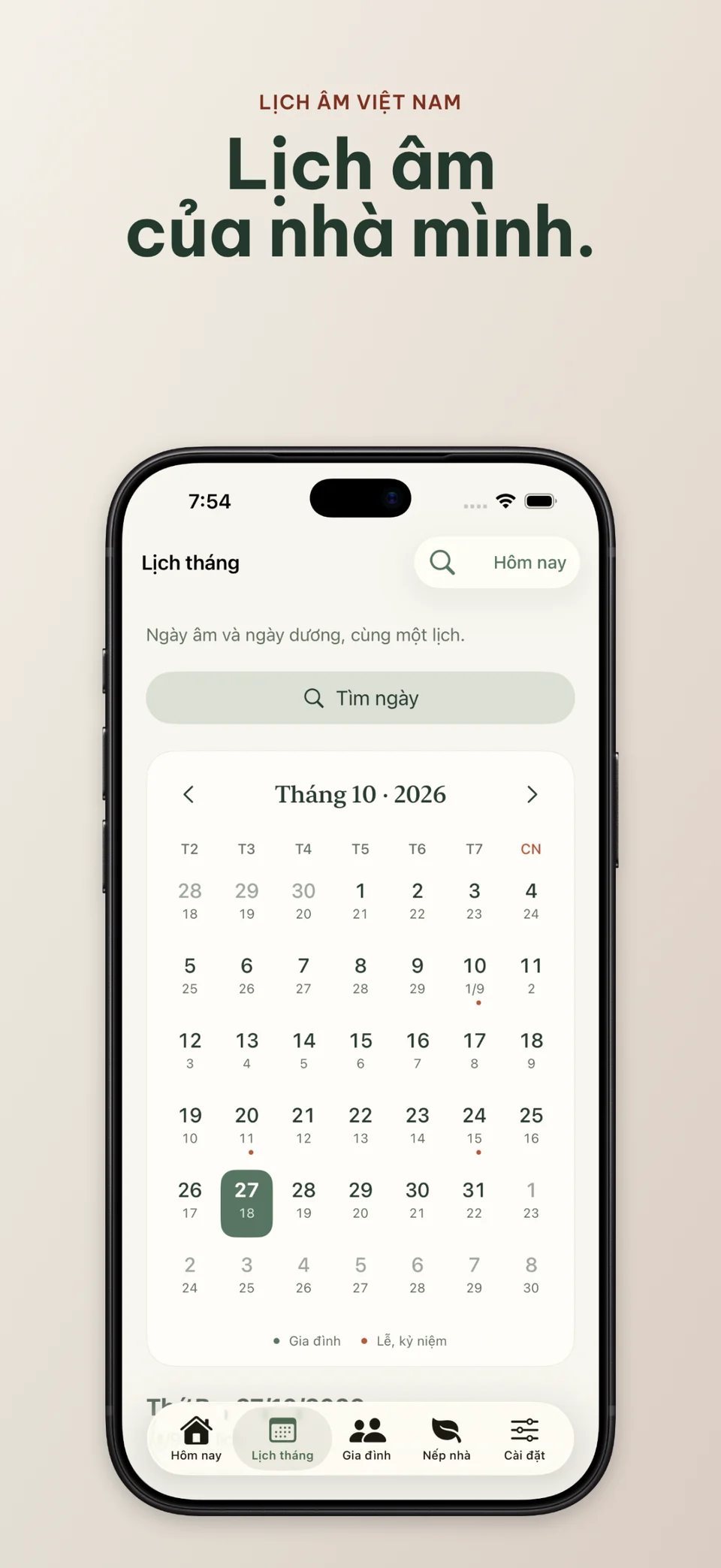
Many Vietnamese families still follow the lunar calendar for death anniversaries (ngày giỗ), the first and fifteenth of each lunar month, and even grandparents' birthdays. That means the date on the regular calendar changes every year. The way to keep track is to understand a few lunar calendar basics, keep everything in one shared list, divide the tasks clearly and set reminders well ahead. This guide walks through each step, including for younger family members helping out for the first time.
What is the lunar calendar, and why do the dates move?
The calendar Vietnamese families call "lunar" is actually lunisolar: months follow the cycle of the Moon, but a leap month is added now and then so the year does not drift too far from the seasons. Each lunar month starts on the new moon (the first day, mùng một) and has 29 or 30 days.
A typical lunar year has 12 months and is about 11 days shorter than a solar year, so the same lunar date lands on a different Gregorian date each year. A year with a leap month has 13 months. That is why you cannot write "Grandpa's anniversary is April 12" and use it forever.
A few basics worth knowing:
- Mùng một: the first day of the lunar month, at the new moon.
- Rằm: the fifteenth day of the lunar month, around the full moon.
- Long and short months: a 30-day month is called "đủ" (full) and a 29-day month "thiếu" (short), and the pattern changes from year to year.
- Use the Vietnamese version: the Vietnamese lunar calendar is calculated for Vietnam's time zone, so it is occasionally a day off from the Chinese lunar calendar. When you look up a date, use a Vietnamese lunar calendar.
The dates Vietnamese families usually keep
Every family's list is different, but it often includes:
- Death anniversaries: based on the lunar date a relative passed away. Many families keep anniversaries for grandparents and great-grandparents on both sides.
- The 1st and 15th of each lunar month: many families burn incense, prepare a meal or eat vegetarian on these days.
- Yearly occasions: Lunar New Year (Tết), the first full moon of the year, Cold Food Festival (3rd day of the 3rd lunar month), Đoan Ngọ (5th day of the 5th month), the full moon of the 7th month, Mid-Autumn Festival (15th day of the 8th month) and the Kitchen Gods day (23rd of the 12th month).
- Lunar birthdays: many grandparents and parents celebrate birthdays and longevity milestones by the lunar date.
- Other milestones: parents' wedding anniversary, or a clan ancestor's anniversary if your family keeps one.
Keep everything in one place
The most important step is gathering every date into a single list with enough detail that anyone in the family can understand it. When dates live in grandma's memory, dad's notebook and an aunt's text messages, something is bound to slip.
Each entry should include:
- The person or occasion and the relationship, for example "Great-grandfather, father's side".
- The lunar date, noting if it falls in a leap month.
- Year of death or birth, if known.
- Where it is held and who hosts.
- Notes: dishes usually prepared, people to invite, your family's own customs.
Sit down with grandparents or parents for an afternoon to ask and write things down. It is also a chance to hear stories about relatives who have passed, something many young people later wish they had asked about sooner. If your family has old records worth preserving, organizing family documents has tips for storing them neatly.
Cases to check with the elders
Some dates do not have a single correct rule, so the best approach is to ask the older generation and write down what your family decides.
- Death in a leap month: families and regions handle this differently. Ask once and note it so you do not have to debate it every year.
- Death on the 30th: in some years that month only has 29 days, so agree on which day to observe.
- The first anniversaries: many places have special observances in the first few years that are prepared differently from regular ones. Note them so nothing catches you off guard.
- The actual gathering day: some families gather a day early, others move it to the weekend so relatives far away can make it. Record both the main date and the gathering date.
Divide the tasks clearly
Clear task sharing keeps anniversaries and holidays from landing entirely on one person, often a mother or grandmother. When you add a date to the list, note who handles what.
- Host: decides the menu, timing and guests.
- Shopping and cooking: can be split by dish.
- Contacting relatives: especially older relatives who do not use smartphones.
- Family far away: contribute money, order fruit or flowers, join by video call, or take a task that works remotely, like ordering cakes or messaging guests.
A private family group makes sharing tasks easier and helps relatives far away still feel present. Staying close to family when you live far from home has more habits like this. If your family uses iPhones, Little Us also offers private groups where everyone can share photos of the meal and the gathering with those who could not come home.
Remind each other before the day, not on it
A reminder on the day itself is usually too late to prepare. Set at least two: one about a week ahead to plan, and one a day or two before for shopping and cleaning.
- If you use your phone's built-in calendar, check whether the event repeats by the lunar or the solar calendar. If it repeats by the solar date, next year's reminder will be wrong.
- Around the start of each lunar year, review the whole list and match each date to the regular calendar.
- Put the preparation tasks right in the reminder, for example "buy fruit, call Uncle Hai".
Lịch Nhà: the lunar calendar app TrioX is finishing
At TrioX Studios, we are finishing Lịch Nhà, a lunar calendar app for Vietnamese families on iPhone, coming soon to the App Store. Lịch Nhà brings the lunar calendar, the solar calendar and your family's dates into one place:
- See today, a monthly view, and look up dates by lunar or solar calendar.
- Save death anniversaries, birthdays and events, with several reminders for each.
- Note what needs preparing, and browse a culture library and regional guides for reference.
- Widgets, an Apple Watch app and complications for a quick look at the date.
- No account needed. Data stays on your device, and you can export a backup.
Read more in a lunar calendar app for families.
Frequently asked questions
Are death anniversaries based on the lunar or solar calendar?
By common custom, a death anniversary follows the lunar date of death. Some families choose the solar date because it is easier to remember. What matters is that everyone agrees and it is written down clearly.
What is "ngày rằm"?
Ngày rằm is the fifteenth day of a lunar month. The full moons of the first, seventh and eighth months (the last being Mid-Autumn) are the ones many families pay most attention to.
How is a lunar birthday different from a regular birthday?
A lunar birthday repeats on the same lunar date, so it falls on a different solar date each year. To avoid forgetting, save the lunar date and set a reminder that repeats by the lunar calendar.